Saturday, December 6, 2014

Destination Patagonia

  
Punta Tombo and the Valdes Peninsula

We started our journey to Patagonia at Dulles Airport bound for Buenos Aires with a plane change in Bogota.  After spending the night in Buenos Aires, we flew to Trelew, a town that is located on the east coast of Argentina south of Buenos Aires and represents a sort of gateway to Patagonia. We rented a car from Hertz, expecting the usual superior cars and service that we regularly get from them.  However, there was only one worker at the counter checking in clients and going to the parking lot with them to locate the cars. Each check-in took at least 30 minutes.  When our turn came, we were presented with a "Rent-a-wreck". There were dents, missing screws that held the fender on, and it was in an overall bad condition. It did have four wheels and four doors. The rep paid careful attention to show us where the spare tire was located and made a point that the only condition related items that they cared about upon our returning the vehicle were the windshield and tires.  We were soon to find out why only those things mattered.  Only a few roads were paved.  The rest were gravel coated, the gravel ranging from boulder sized to fine powdery sand, so most of the damage that showed up was either to the windshield or tires.  The rest of the car suffered so many dings and dents from so many renters on so many bad roads that no one could have figured out who did what or when it happened.

We spent our first night in the small town of Gaiman. Gaiman is a Welsh village where over three thousand Welsh emigrants arrived in the late 1800's and set up homes, shops and farms.  Today many of the homes are B&Bs and Welsh tea houses. We stayed in a B&B called Betsy Plas y Coed. The owner mentioned that the B&B was her grandfather's home.  The inhabitants of the town today are a mixture of Welsh ancestry and Argentine as well.
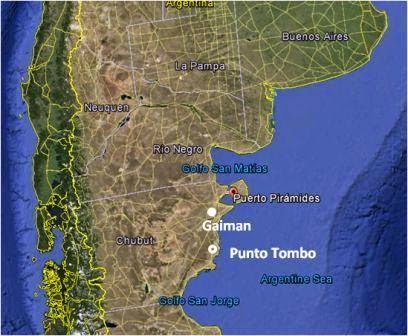
 
We departed Gaiman early the next morning for a three hour drive to Punta Tombo, which contained one of the largest colonies of Magellanic penguins in the world.  The colony covered a vast area, and thousands of penguins were scattered about.  They were coming from the sea, going to the sea, sleeping in shady nests under bushes, walking on the boardwalks and trails with people and just going about their penguin business as if we weren't even there. Several chicks were in evidence, but just barely.  Their moms kept them cool and shaded from the hot sun under the bushes.

The sight of the penguin colony itself was a bit otherworldly, since once out of the ocean, the Penguins were living and thriving in an arid, desert like environment, kind of like seeing penguins in the Sahara desert and thinking it normal for them to be there.  One wouldn’t ordinarily think of this place as a home to sea-going birds, but they’re quite happy and protected there.


After a good hike around the penguin colony, we departed for Puerto Piramides, a small village on the Valdes Peninsula and a UNESCO World Heritage site.  We decided to wait until we got there to book or not book a whale watching cruise, since we thought it would be wise to know if this was whale season (or not.)

At this point, I should digress with a humorous story about a BMW. We checked into our accommodation in Puerto Piramides, called "The Paradise" (probably good for another digression).  As we were signing the registration book, there was a place to put the details of the car you were driving. The last person who checked in just before us noted he was driving a BMW. We thought, "Wow, who would bring a BMW to a rough place like this with the unpaved roads and dust everywhere?"  We then looked in the car park and saw no BMW, so we concluded that this person was probably referring to the car he drove back home.  Next day, on a whale watching cruise, we met the owner of the BMW.  He had his BMW motorcycle shipped down from the states and was traveling through South America with it!  Then, to top it off, he mentioned that he was born and lived for a while in Montgomery, AL, Dave’s birthplace and childhood home town.

So, The Paradise didn't exactly live up to its name.  We actually booked a B&B called Hidden House, but we received an email the night before our arrival saying that "due to technical difficulties" the owner was moving us to the other property he owned and was upgrading us to a suite.  It was ok, except for the bathroom sink, which was smaller than most RV sinks.  We got the housekeeper to clean the mold off the bathtub grout, too.  And if you went to breakfast soon after they opened, you got yesterday's leftover coffee.  Cereal was plentiful but cereal bowls were not. After staying 3 nights, Hidden House is still in hiding, and “The Paradise” did not really live up to its name.

We are still trying to adapt to the timing of meals. Lunch is served from about 12-3 PM, and dinner usually starts around 8-11 PM. Not much is open in between.  Breakfast is usually included in the room rate, but if you want to get an early start or you have an early flight, don't expect to even get a cup of coffee, since no one is usually around until 8:00 AM. There was no flexibility with these rules, and no substitutions were allowed on menus that we encountered.   We so take for granted all of the conveniences we live with in the U.S!  And did I mention, all of those dollars we brought to change into local currency have been useless, because no one changes money here, and in most places, credit cards aren’t accepted, either.  We concluded that it’s a gimmick executed by the banks to charge tourists about $8.00 USD for each limited ATM withdrawal they make.  But wait, if merchants accept US dollars for payment,  they often give you 30% more than the official rate. 

Well, back to our travels. Our exploration of the Valdes peninsula started with a whale watching cruise. We've been on others, but none like this one.  Within minutes, we spotted our first behemoths--Southern Right Whales, a mother and baby. This whale species comes here to give birth and spend a few months nursing its calf before returning to the nutrient rich waters of Antarctica to resume feeding. The first whale family was fun to watch and photograph until we spotted another family that was breaching and fin slapping.


We quickly moved to watch them and were excited to see them put on such a great show for us and our cameras.

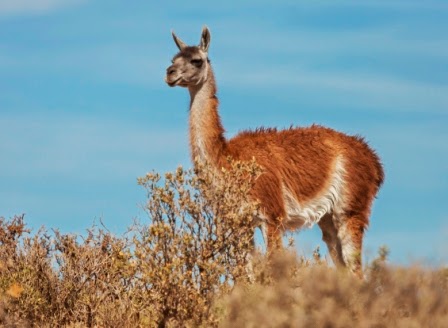
Later the same day we braved the gravel roads to tour a bit of the peninsula. We arrived at a lookout called Caleta Valdes on a bluff overlooking the sea where there was a protected area for sea lions and elephant seals to relax in the sun.  We could see a tour bus, vans and several cars at the lookout, so we figured there was something happening.  Now, if I can back-up just a minute, I should mention that I saw a nature documentary that was filmed in this area showing orcas patrolling the protected shore areas in search of seals.  When they caught one entering the water, or when they practically beached themselves in order to snatch one, they threw it around in the air several times almost playing catch with it and each other before they killed and ate it.  I asked our whale cruise guide about this event, and she mentioned that it normally occurs in February and March when the baby seals are just venturing into the water and not on guard against this primary predator. Therefore, we had no expectation of witnessing such a gory thing.  But getting back to the story—we found a place to park, and as we approached the viewing area, we heard oohs and aahs.  People were standing 3 and 4 deep to witness the aforementioned event.  The orcas can only access these sheltered coves around high tide, which was how we planned our timing.  Unfortunately, we didn’t get a good view until the orcas finished playing with the seal and were just pushing its head around.  We were all hoping for the seal’s sake, that it was already dead.  We couldn’t see if it still had an intact body attached to the head.  In addition to the whales and orcas, this area is rich in other fauna—guanacos, rheas, elephant seals, sea lions, and various sea bird species thrive here.


Argentine Patagonia


For our next destination, we flew to El Calafate in southern Argentina near the border with Chile.  Once again, we faced off at the Hertz counter where we had booked another rental car.  This car was the same make and model as the last one, a Chevrolet Classico, but looked marginally better except it was missing a hubcap.  The dents and dings were smaller and not as numerous (more paved roads), and it was a little cleaner.  The only instructions from the rep this time had to do with not opening both car doors at the same time, because the wind is so strong here that one or both doors can blow off.  OK!  So we packed our gear in the trunk, started the car, and oops! the engine light came on.  We quickly pulled up in front of the terminal; I ran back to the counter, and guess what?  They had already closed and locked up for the day.  The airport is so small that they only need to be there for the few flights that come and go.  But, in 5 minutes, everyone was gone?  So, we went back into the parking lot and Dave called the Hertz rep for assistance.  “Oh, we forgot to tell you, we had to change the battery, but we don’t have a computer to reset the engine light.  But, all is good!”  Ok, so we started off again. 

We drove about 2 ½ hours to reach our new destination, El Chalten.  The road was a lonely one.  There were no towns at all; only remote estancias (ranches) that had so little vegetation that hardly any animals were in evidence grazing.  There were a few sheep here, and a few horses there. Since we never passed even 1 gas station during the whole journey, we decided to locate the 1 gas station in the town and fill up for the trip back in 3 days.
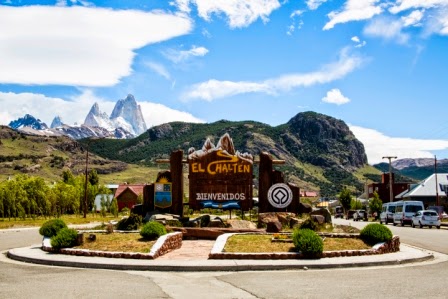

We unknowingly passed the station on the way into town, but because it was so small, we didn’t even see it.  As we pulled in to get gas, there was a car in front of us whose driver was having a discussion with the attendant.  As it turned out, there was no gas.  When will they have some?  “Mañana”.  So, we know that mañana can mean tomorrow, but it can also mean “whenever”.  So, to be on the safe side, we went back to the station the next morning after breakfast and before our first hike.  As luck would have it, there was a fuel truck there filling up the tanks and about 10 other cars waiting in line.  It was a little reminiscent of the gas crisis during the 70’s in the states when gas lines reached for blocks because of the Arab oil embargo.  Aah, but we were patient. We waited until the truck filled the tanks.  We waited until the cars in front of us got their gas.  After we filled up, we figured it took us about an hour to complete this simple transaction.  Oh yes, the conveniences of home!
The primary reason tourists come here is to trek and hike.  As you watch folks traveling the streets with packs on their backs, you are struck by the fact that they are mostly all young (we’re the exception).  They’re also very fit and originate from a diversity of countries.  They’re the ones that Darwin would have referred to as adapted for survival.  Even when you see them après-hike in a restaurant eating french fries, you know they earned the calories by hiking 10 miles or so.

Our hike today was to Laguna Capri, which is a vantage point for a good view of the famous mountain range here called “FitzRoy”.  And, of course there has to be a story about the name FitzRoy, but I don’t know what it is.  It was a 7 km. walk (round trip) or maybe climb is a better word, since the elevation gain is 350 mtrs. or about 1,000 ft.  The whole trek to the lake was uphill, which was only comforting when you took solace in the fact that the return to town was downhill.  Add to the elevation gain a strong head wind with gusts about 30 + mph, occasional rain mixed with sun, and very cool temperatures.  We knew that this situation was normal weather here, so we were prepared with proper clothing, etc.  There were beautiful views along the way, but Fitzroy was shrouded in clouds. 

Our new accommodation is called “Lo de Tomy”.  We’re not sure what it means, but it’s paradise compared with “The Paradise”.  We have a 2 story townhouse apartment with a kitchen, sitting room, bedroom and 1 ½ bathrooms.  The proprietor is very meticulous; breakfast was quite good, and she even delivered homemade pastries and coffee to the room for our return from hiking.  This town seems more tourist friendly than the last one.  Some shopkeepers will accept dollars at a good exchange rate, although there is still no place to change money.

During the evening after our hike and dinner, the wind went from normally strong to hurricane force.  Very strong gusts of wind rocked the car outside, and we could feel the building moving.  It blew out the internet and phones, and the loud whining and roaring was audible all night long.  My thoughts turned to those lonely, isolated ranches out in the empty hinterlands.  Before the age of television and computers and even phones, how did those pioneers keep from losing their minds with only the sound of the wind to keep them company? 

(Blog comments and Photos to continue. More Photos to be loaded on to website on return.)


Tuesday, May 28, 2013

Renée and Dave 43rd Anniversary Trip


We continue to “Live Our Dream” and celebrate our 43rd Anniversary with a trip to the Pico Bonito National Park in Honduras.  We are staying at the Lodge at Pico Bonito and hope to see and photograph lots of wildlife and partake in various hikes and snorkeling at Cayos Cochinos , part of the Mesoamerican Barrier Reef System.   


Friday, February 8, 2013


Land of the Ice Bear


We’re all familiar with the phrase, “If you build it, they will come”. How appropriate this quote turned out to be at a very remote arctic lodge in the middle of the tundra on Hudson Bay! A family built a very warm, hospitable lodge in an otherworldly white landscape in Northern Manitoba, and they came. Who are they? Polar bears and tourists came, and the visitors loved what they witnessed without disturbing the bears.


Our journey to the lodge began at 4:00AM with a flight from Winnipeg, Manitoba’s capital, to a small frontier town named Churchill, 3 hours north by air. Upon descending the steps of the plane onto an icy tarmac, an arctic blast of frigid air hit us in the face just to remind us where we were. We and the other 16 lodge guests collected our luggage and half of us transferred to a small single engine plane for the ½ hour flight to the lodge’s airstrip. The plane had to make 2 trips, since there was only room for 9 passengers, their bags and needed groceries and supplies for the lodge itself. The small plane is the lifeline for the lodge since there are no roads in this location. Anything too large to transport on the plane has to be delivered when the bay freezes over; then it can be trucked or sledged in over the ice.


Speaking of the bay freezing over, this event is largely responsible for the timing of our November trip. Polar bears hunt on the ice. It’s their habitat. So, from December, when the bay freezes, until spring when it melts, the bears are quite happy hunting and eating seals, their main food source. Once the bay thaws, the bears come onto land, and for about 5 or 6 months, depend on their fat reserves from their seal meals to live. They may occasionally find or scavenge something such as berries or seaweed, but by November they are pretty darned hungry! They head to the bay and wait for the water to freeze. The lodge has been strategically built just above the tide line on Hudson Bay near the Seal River, a known place that polar bears gather to go out hunting. So, I guess it shouldn’t have been surprising that within 15 minutes of arriving at the lodge, a polar bear sauntered by the building very nonchalantly as we were warming our hands with hot tea after just making the trek from the airstrip to the lodge. If we’d been just a few minutes later, we would have run into the bear as he was passing the front door.


This might be a good time to discuss how we weren’t substituted for a seal meal by the hungry bears. Apparently, in most cases polar bears don’t really see humans as food. They do however, have an extraordinary sense of smell and can smell food from about 10 miles away. Whenever we left the lodge grounds on our hikes, we were accompanied by two guide/naturalists who understand bear behavior, and have a retinue of deterrents, including a gun. We never felt threatened by any bear. Mostly, if a curious one was heading in our direction and got a little too close, a clap of the hands was enough to send it running in the other direction. A noise deterrent did have to be used once during our visit to scare a bear away from the owner’s private plane. The bear jumped up on the plane and seemed to want to raise a little havoc. He was scared away by the noise.


Our days began as daylight dawned around 8:00AM or 8:30AM. We would alight from our rooms and wander out to the lounge for coffee followed by breakfast in the dining room. The dining room had panoramic windows gazing out on an icy, arctic world. The colors, shapes and forms were of a place we’d never witnessed before. So many shades of gray—“Fifty Shades of Gray”—might do it justice. There was a deep gun metal gray of the sky before and after daylight and when cloudy. Gray tinged with blue, pink, mauve, yellow and gold were also in evidence as the sky kept changing and morphing with the time of day and the cloud cover. After breakfast, an announcement was made each morning detailing the morning activity. It was always an outside activity, sometimes a hike and sometimes, if the bears were active around the lodge, the activity would be centered nearby. So, we returned to our rooms and donned our layers of arctic gear. Multiple pairs of wool socks with foot warmers for our toes, arctic boots, snow pants, arctic coats, scarves, ear muffs, hats and hoods, and gloves—glove liners, hand warmers and finally outer ski gloves were put on. Once attired, we quickly went outside to avoid sweating under all those clothes. I couldn’t decide if I felt more like the Michelin Man, or I should pretend I was preparing for a moon walk. The temperatures were typically in the teens (Fahrenheit) with a stiff wind bringing the wind chill factor way down, how far down--I didn’t want to know. As the days passed, the temps actually rose a bit.


Since the outdoor activities were geared for photography, we tended to forget the cold as we set up our tripods and camera equipment and happily clicked away getting good images of the bears or the red foxes that were abundant. We had two professional photographers in the group who were helpful in advising us on our camera settings. There was also a BBC film crew attempting to get footage of the arctic foxes for a documentary series called “Survival”, set to air in 2014. Unfortunately, the arctic foxes are smaller than the red foxes and had been driven off by their larger cousins. Afternoons were similar to the mornings. We generally stayed outside anywhere from 2 to 4 hours. Once inside, we were greeted by hot beverages and a warm fire in the lounge. Meals were excellently prepared and delicious. We tried a few local delights such as moose tenderloin and a caribou appetizer. But on the whole, meals featured comfort food, and we marveled that in this wilderness, fresh fruits and vegetables were generously served at every meal. I brought back the lodge’s delicious recipe for granola and have already made it.


Each evening, as we enjoyed wine and hors d’oeuvres, a program was presented by one of the lodge naturalists or the BBC film crew. There was no TV or radio, so these programs were our entertainment. We also enjoyed interacting and conversing with the other guests, who all had similar interests to our own. Americans, Canadians, Australians and British folks composed the group of 18 with which we shared our experience. And as the day wound down, we returned to our cozy rooms to enjoy a good night’s sleep in the dark and silent northern night.


For more photos, please see our website, http://reneecapouya.zenfolio.com. Go to Canada, Churchill Polar Bear Safari. (http://reneecapouya.zenfolio.com/f990216655)


Or see a video clip @:  http://reneecapouya.zenfolio.com/p708147747#h4f81f890


Wednesday, December 14, 2011

Aitutaki Atoll
6 - 10 December
_____________________________
Paradise Found!
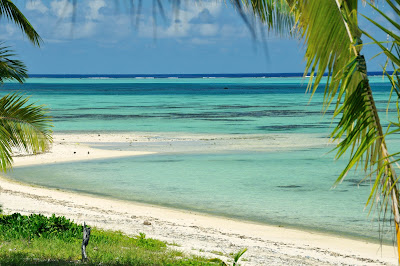
Well, this is our last blog of the trip--the encore, ‘the save the best for last’ portion of the journey. We made our way from Auckland to Rarotonga (one of the Cook Islands) on a late flight, spent the night, and then flew to the atoll of Aitutaki. As the plane descended to land, there was a collective gasp from all on board the small plane. The island scene was just breathtaking! Think of the most beautiful South Pacific Island of your dreams, and there we were. A huge shallow lagoon and coral reef surrounded the island, with crystal clear water in all shades of turquoise fringed with sandy beaches. The island itself is an intense green with forested hills.
The Lagoon - Aitutaki
We were met by our hotel representative and driven to the resort. It only took five minutes to get from the airport to the resort. We and another couple from New Zealand were greeted in the lobby with a refreshing drink in a coconut by Steve & Amanda, a young couple from Vancouver, who left careers on Windstar Cruise Lines to manage this resort. We later found out that Amanda was the cruise director on a Windstar cruise that we took in 1999 in the Mediterranean.
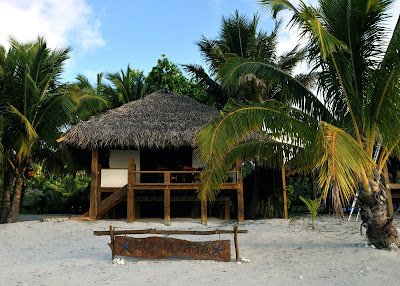
The resort is a small boutique type of hotel composed of 8 bungalows set on or near the beach. We are currently sitting in our beachside bungalow enjoying tropical breezes. Our view from the front porch is of the lagoon and coral reefs. Further out, waves from the ocean are crashing against the reef. Ah, paradise! The sky is an intense blue, bluer than we’ve ever seen, probably due to the lack of any pollution in the air. The colors of everything here seem to be on steroids—ramped up several notches.
Our Beachfront Bungalow
This is truly island living. Dave, always up early, was out on the front porch the next morning drinking coffee when a family of chickens climbed the stairs to the porch for a morning greeting. Last night, the reception office staffer had to call ahead for us to see which restaurants were actually open for dinner. She also called and learned that the taxis weren’t operating that evening, so she gave us the keys to the hotel van to go to dinner. There doesn’t seem to be much stress here, but rather a laid back, enjoy life type of philosophy. Works for us, but could be difficult for others used to the fast paced American life, with nary a minute to lose. Australia and New Zealand also have a degree of ‘enjoy life’ attitude as well.
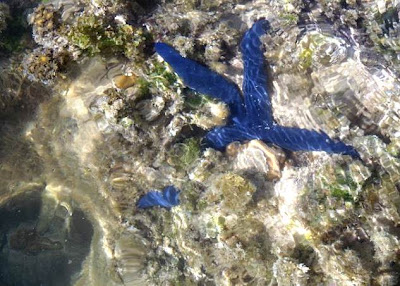
We’ve been snorkeling every day. A short walk from the bungalow to the beach to the water and there is our snorkeling adventure. You could literally snorkel for hours around the coral observing all of the beautiful fish, blue starfish, giant clams, sea urchins and interesting varieties of coral. The water is quite shallow and protected, so you literally feel as though you are snorkeling in a giant aquarium. It’s so relaxing just to float along and watch the fish dart in and out of the coral. The only negative is the huge quantity of sea cucumbers on the ocean floor. The sea floor is literally covered with them. They don’t bother you or anything. It’s just unsightly to see these slug-like creatures all over the place. Well, there is one more negative. We had just started to photograph the life of the reef underwater when the underwater camera housing got water in it somehow. So, now, no photos of life underwater!
Blue Starfish in the Lagoon
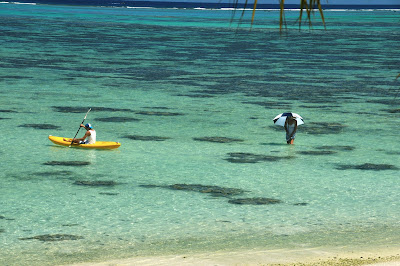
We also kayaked in and around the reef and were able to see all of the life in the crystal clear water. Again, the area was so protected that even a novice kayaker would have had no problem maneuvering around. Our days were so relaxing and enjoyable that at times we felt as though we were revisiting our childhood. The swimming, snorkeling and kayaking were reminiscent of summers long gone when there were no adult responsibilities with which to deal.
Kayaker and Umbrella Lady
We met a really nice couple from New Zealand with whom we ended up sharing our adventure over meals and a tour of the island in their rental car. It was great to meet new friends and compare notes.
As all good things must end, we reluctantly prepared to leave the island at the end of our stay. This island was the perfect way to end our long 5 month journey.
EPILOGUE
Statistics: 16 countries, 54 flights, 73,662 air miles, 76 hotels/lodges, 11,405 land miles, and 6 rental cars. All together, the mileage equals 3.4 times around the world at the equator.
One cannot make a trip like this one without finding new perspectives and world views. It’s a mind expanding experience. Occasionally, our limits were tested, as in the grueling 9 hour vertical hiking experience to see the gorillas. More than once, there was a feeling of, “I don’t think I can do that.” Then, you do it, and discover that what you thought was impossible was actually possible. Some have asked, “Aren’t you exhausted from all of the travel?” They’re surprised when we say that we’re not tired at all, but energized. The experiences of seeing so many earthly wonders all in one trip is beyond amazing. We feel so privileged and fortunate to have been able to have this experience. And, we look forward to more adventures in the future!
Pictures: Due to the additional number of pictures we wanted to post for New Zealand, please view them at our photo website below.

Monday, December 12, 2011

New Zealand
17 November - 7 December
_____________________________
Our first impressions of New Zealand include strong reminiscences of other places we’ve visited. The intense green of the landscape reminds us of the British Isles. The fiords bring back memories of Norway. The gentle slopes of the mountains have a feeling of Switzerland about them. The aquamarine alpine lakes and glaciers look like those of Banff and Jasper National Parks in Alberta, Canada. Geysers, hot springs and mud pots are similar to those of Yellowstone National Park. The beautiful turquoise shades of the ocean and sandy white beaches are similar to those on the Caribbean. But put all of it together, and it becomes uniquely New Zealand.
In large part, due to New Zealand’s geographical isolation, flora and fauna developed differently here, especially animal life. There were originally no mammals in New Zealand, except the ones that could swim here (seals and whales) or fly (bats). There were many indigenous species of birds and insects. The birds had no predators, so over time, they became ground animals, rather than flying ones. Then, humans arrived. The first Polynesians coming ashore brought rats and dogs. Later, the Europeans brought sheep, cattle, stoats (weasel like), deer, cats, goats, and many others. The end result was that the native birds were decimated; many became extinct. Therefore, we’re not expecting to see a great many animals and birds, as we have in other countries. The main attraction is the beautiful scenery.
To illustrate the point about the introduced animals wreaking havoc, there is an interesting story to relate. We haven’t done much shopping on the trip. But we knew that New Zealand was famous for its wool and wool products. So, we visited some local shops selling wool items. To our surprise, the products were all labeled as containing wool and ‘possum’. Now, we live practically next door to Appalachia, so the idea of taking a souvenir home and giving it to someone when it contains ‘possum’ is not really acceptable, no matter how nice and soft it is. Besides, Renee doesn’t buy items containing animal fur. When we asked in a rather frustrated voice, “Aren’t there any items without possum fur in them?” The saleslady’s answer was rather surprising. She said that killing the possums and using their fur was one of the most environmentally sound policies that New Zealand has. The Australians, at some point, introduced the possum here for the fur trade. Since then, they have multiplied exponentially until there are millions and millions of them. Possums have killed off the native birds and caused other damages, too numerous to mention. So, in attempts to eradicate them, New Zealanders are trapping them, killing them, and using their fur to enhance wool products. It makes sense for them to do this, but there is still a cultural disconnect when it comes to us buying possum and giving it as gifts!
The South Island
Nov. 17-19
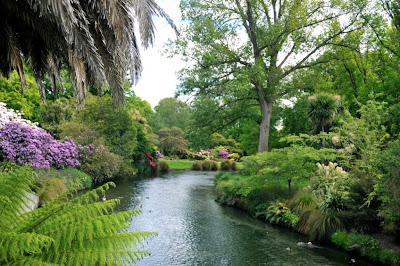
We arrived in Christchurch late at night, so we decided to just take it easy the next day. After a good rest, we set out on foot to explore the town. A visit to the Botanical Gardens was first on the list. It was a really peaceful, beautiful place with huge trees, shrubs, flowers and birds. This is springtime in New Zealand, so the azaleas and rhododendrons are blooming, as well as roses, peonies, irises and many other flowers. We emerged from the gardens into the downtown area to find the serenity of the botanicals shattered by the damage visible from the February 2011 earthquake. It was really sad to see so many buildings damaged and destroyed. Whole blocks of downtown Christchurch are fenced off to the public. Rubble is still being trucked away; cranes are in the rebuilding process. We hope all goes well in the rebuilding process for these very warm, friendly, hospitable and resourceful people.
Christchurch Botanic Gardens
Next morning, we headed 2 plus hours north along the coast to Kaikoura for a whale watching cruise. There are large whales here year round because the ocean currents converging in this area produce nutrient rich waters. As we reached the check-in counter, we learned that our cruise had just been cancelled moments before due to high winds and unsafe sea conditions. Darn! Oh well, no one can control the weather. Better to cancel than to have everybody on board sick!
Nov 20 Queenstown
This was a stopover place for the trip to the Fiord Country. Queenstown is a beautiful town set on a lake overlooking the mountains. As luck would have it, the clouds and rain kept us from enjoying the scenery.
Nov. 21-23 Te Anau, West Coast
We came to the southwest coast of New Zealand to see the stunning scenery, namely the fiords in Fiordland National Park. These fiords comprise some of the most beautiful scenery in the world. Interestingly, the fiords where we booked scenic cruises are named Milford Sound and Doubtful Sound. When the fiords were discovered, the only English word known to describe them was ‘sound’. They aren’t sounds, because sounds are carved out by rivers and then fill with seawater. Fiords, on the other hand, are carved by glaciers and then fill with seawater. Later, when the Norwegian word ‘Fiord’ was introduced to English, the error of the names was discovered, but the names had already stuck, so they weren’t changed. The national park, however, came later, and was named correctly.
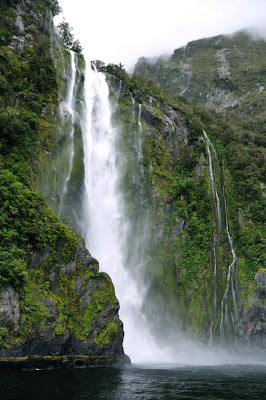
We first cruised Milford Sound. Sheer vertical mountains, covered in verdant forest, plunge down into the water. Waterfalls are seen frequently; they too, plunge into the sea. This area is one of the wettest places on earth. Rainfall is measured in meters here. The frequent rain causes the waterfalls, as the water runs down the mountains. Some of the waterfalls are temporary, materializing after a shower and then drying up. Others are permanent.
We enjoyed the cruise and all of the beautiful waterfalls. We were able to see seals basking on the rocks and penguins coming ashore. The penguins were crested penguins—they were beautiful with long yellow feathers looking like eyebrows. On the drive to the ‘sound’ we spotted parrots called kea. They live in a very cold alpine environment. They look very hardy with heavy coats of feathers. They spend a lot of time in parking areas and will jump on cars or busses and peck at any rubber or plastic trim on the vehicles. We heard that they cause thousands of dollars worth of damage every year with their very sharp beaks.
Milford Sound Waterfall
We also had a cruise of Doubtful Sound which was a longer and more extensive boat ride. It was similar to the first cruise except that it poured rain the whole time so it was difficult to see much except rain and mist. On the way back, we stopped at an underground hydroelectric power plant. It was located about 600 ft. underground and was accessed by bus. There was a tunnel that ran the whole way down to the station and was wide enough for busses to drive into and turn around at the end. This plant may be the largest engineering feat that New Zealand has created. The plant uses water from the adjoining lake to create hydroelectric power. It might have been one of the first renewable energy plants built on a large scale. Speaking of renewable energy, New Zealand is able to get more than 70% of its electricity from hydroelectric and geothermal sources.
Nov. 24 Driving Day
We set out from Te Anau in the morning in order to reach our destination, Franz Joseph Glacier, by late afternoon. It was a sunny, beautiful day. As we started the journey, backtracking from a few days before, we noticed how different everything appeared compared to the day we drove the other way. The difference was due to the weather. The first drive was in the rain, mist and low clouds. This day’s drive in the sun was glorious. Before us the hills were carpeted in lush, green velvet. Sheep and cows were everywhere. New Zealand has many more sheep than people; the ratio is about 12 to 1. All of the animals look so clean and healthy in their pristine meadows and fields.

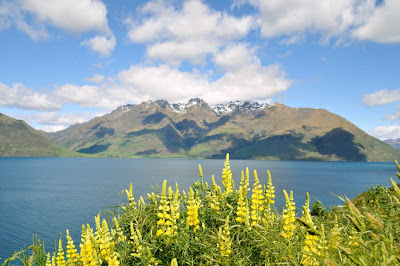
But the real difference in the drive was in the brilliant colors of the stunning alpine lakes that we followed for most of the day. The blues of the lakes combined with bright yellow wild flowers and intense greens of the grasses and trees. Take all of that and put it against a backdrop of multihued bluish mountains, some of which are still snow capped. Wow! What a gorgeous day we had! It’s no wonder that before you fly to New Zealand, you must present your airline ticket to leave the country. There would be a temptation to stay here otherwise.

Lake Wakatipu, near Queenstown

Nov. 25-27 Fox and Franx Josef

We came here to see and hike to 2 glaciers: Fox and Franz Josef. The unique thing about these glaciers is their geographical location. They are near the mid coast of western New Zealand. This area receives meters of rain each year, thus, the vegetation takes the form of a temperate rain forest. As you emerge from the rain forest, there is a virtual gray wasteland of rocks and stones which goes right up to the glaciers. Also because of the abundant rainfall, the adjacent mountains receive the precipitation in the form of snow at the higher elevations, lots and lots of snow. Hence, the glaciers were born and exist still. The terminal ends of the glaciers are found at only about 800 feet above sea level, making them easily accessible to the public. We took a short hike to each glacier. One can appreciate the sheer size and mass of the glaciers as one approaches closer. The ends of the glaciers visible on our walks were primarily white and black—white ice, black debris and a very little blue color showing through some of the fractures. Together with the gray of the rocks, it could easily have been a scene of black, white and gray without any other colors.

Next day, we heard about a wildlife sanctuary that offered tours to see the white herons’ nesting colony. This nesting area is the only one in New Zealand for white herons, so we thought it would be a good idea to check out the tour. We traveled about a half hour north of our motel to a town called Whataroa. From there a minibus took us to a dock (about an 8 mile trip on a dirt road). At the dock, we boarded a jet boat which took us on a 20 minute ride down a shallow river, through a bay next to the ocean, and then to the bird hide in the Westland rain forest long another river in the Waitangiroto Nature Reserve.

As we walked the boardwalk to the birds’ nesting area, the rainforest flora unfolded before us. There were white pine trees that were 900-1,000 years old, looking all gnarly and covered in epiphytes. Small native green hooded orchids were blooming along the sides of the boardwalk. And tree ferns, which reminded one of the dinosaur era recreations, grew in profusion around us.

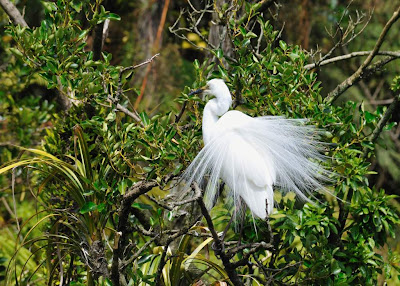
Then, we reached the bird hide. As the wooden sides of the hide were opened for us, a dazzling array of brilliant white herons in their wispy, feathery breeding plumage awaited us. As one looked more closely, the more one saw. The herons had nests with chicks of varying ages in them. Some were quite tiny; others looked like they were ready to fly soon. So, we kept looking and the next thing we saw were the royal spoonbills, which also nest here. They, too, had beautiful breeding plumage, not wispy and feathery like the herons, but perched on the tops of their heads. They were bright white with black spoonbills. Their nests were built in the trees above those of the herons. Also present and nesting were some little cormorants, called “shags”. It was a very busy place with lots to see, observe and photograph. It was well worth the trip out there.
White Heron with breeding plumage
The North Island
Nov. 28 Auckland
We arrived in Auckland in the afternoon after a short flight from Christchurch. As we were pondering what to do for the rest of the afternoon, we recalled seeing directions to a winery that was featured in the Air New Zealand magazine. Hmmm! Sounds good! So, we went to the winery to have a late lunch at their café. We drove through an industrial area with huge warehouses, a very unlikely place to find a winery. But, as we made the turn from the main road, the scenery quickly changed from industrial park to vineyard beauty. The vineyards were fresh and a lovely green in the spring sun. We sat outside and ordered lunch.

While waiting for our order, Renee went inside to peruse the wine selections. A wine employee working behind the counter called her over to a tasting. Not wanting to leave Dave out, she called to him to come and join in. We tasted some wines, then participated in a research and development project of tasting some blends that are being considered for bottling. The food was good; the wine was even better! A great afternoon was had by all. It looks like we’ll be enjoying the north island!

Nov. 29 Coromandel Peninsula
We left Auckland and headed south. There was plenty of time to get to our next destination, and it was a nice day, so we detoured for a drive around the scenic Coromandel peninsula. It was a lovely drive with lots of coastal scenery, huge, old trees, gently rolling hills and mountains--everything to make a picture perfect day. Around lunchtime, we drove by an area that had oodles of mussels and lots of oysters. Naturally, we stopped at a little roadside stand and got oysters on the half shell and mussel chowder for lunch. It was all fresh and delicious!

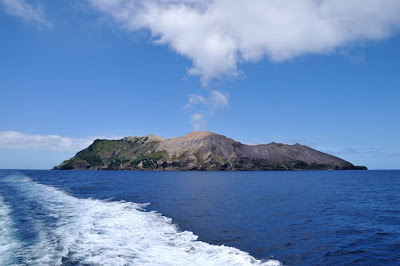
Nov. 30 White Island Volcano
We spent the night in Whakatane in preparation for a morning cruise out to New Zealand’s most active volcano, White Island. It was touch and go until the last minute as to whether the boat could actually safely go and land at the island because of strong southeasterly winds. As it turned out, all went well; the winds died down and we had a beautiful day. The boat we rode on was a luxuriously outfitted 80 ft. + cruiser. Shortly before landing, we were issued hard hats and gas masks. The masks were to be used if we felt that the fumes from the volcano were causing us respiratory distress.
White Island

The boat anchored offshore, and we were all transported to the island via rubber dinghy. We then spent about 2 hours on a guided tour of the volcano and its crater. We were actually in the crater, because it had collapsed during one of the eruptions. This day was a reminder that we don’t live on a dead rock of a planet. The planet we live on and think about on a daily basis is just a thin crust above a seething, boiling, incredibly hot mantle and liquid core. As we walked, we witnessed the power of nature in a spectacular show of steam rising from fumeroles and from the center of the crater itself. The smell was of acidic sulfur. Colors ranged from yellow to light green pools in the center of the crater (the green was sulphur mixed with arsenic). There were gray and brownish bubbling mudpots, too. Reds and pinks were mixed in on the walls of the crater, owing to the different elements and minerals in the rocks. This scene was set against a backdrop of blue sky and bluer sea. It was really an incredible sight, and we felt as if we were on another planet than earth.

Dec. 1-3 Rotorua
This area of New Zealand is known for its volcanic and geothermal activity and sights. We visited an area called Wai-o-tapu thermal area, the largest area of surface thermal activity of all the areas in this volcanic zone. We hiked through three areas in this park. There were many colorful and interesting sights to see. Among them were collapsed craters, some containing hot water springs and sulphur deposits. Most of these were formed when acidic steam rising from underground dissolved the ground above, causing a cave-in. Other areas contained pools of water colored by various minerals, making them many different hues.

Artist's Palette

One fact we found interesting was that some birds have adapted to this harsh environment. We saw pied stilts walking in the acidic waters. They have made a home here and feed on the insects that live in the area. Other birds such as starlings and swallows make their nests in holes of the walls of one of the craters. The heat coming from the crater below helps to incubate their eggs. Also flourishing in this park is the tea tree. Many herbal preparations are made from the tea tree, including skin remedies such as shampoos and astringents. They were growing everywhere and blooming at this time of year with white flowers. They have adapted to growing out of rock and areas where there is very little soil.

It was a new day, and there was yet another volcanic area to discover. The Waimangu Volcanic Valley was formed when the Tarawera volcano erupted in 1886, making this valley the world’s youngest geothermal area. We hiked for 2 hours through the trails to see all of the craters, hot springs, lakes, forests and other sights of Waimangu.

The first sight we beheld was a red colored lake, actually the southernmost crater. The red color was caused by a particular kind of (micro) fern growing in the water. We continued on to see other wondrous steaming, boiling pools, lakes and collapsed craters. When we looked out at the fumeroles and steaming lakes fringed with large fern trees, our first thought was that this must have looked like the world that the dinosaurs inhabited. The second thought was that these sights could be on another planet altogether, as they were so alien. There were many hot springs, and as they bubbled and boiled, the minerals in the water created bright colors that mixed with algae to create an artists’ palette of hues and shades. We also viewed ‘terraces’, which are platforms made from springs depositing minerals and silica. The silica builds up over time to create terraces and mixes with algae and other minerals to make a colorful sight.

Waimangu Marble Terrace

At the end of the walk was Lake Rotomahana. We cruised the lake in a boat and viewed more fumeroles, hot springs and geysers. The lake itself was increased in area dramatically by the eruption of 1886. Tons and tons of rock and magma were ejected out of this area, which then gradually filled with water to create the lake that exists today. Near the steaming fumeroles and hot springs, black swan families swam serenely. We also viewed scaups (ducks) in rather large numbers. The lake is stocked with trout, too. Although the weather called for rain on this day, it was partly cloudy, allowing us to have a good walk and tour with no weather related issues.

Dec. 4 Otorohanga and Waitomo
We left Rotorua in the rain and decided to go to the Otorohanga Kiwi House/Bird Park and the Waitomo Glowworm caves before venturing on to Auckland. We wanted to see the kiwis, and the best (and mostly only) way to do that is to visit them in one of the sanctuaries. It is practically impossible to see a kiwi in the wild. First, they are nocturnal, so they don’t appear much during the day when humans are likely to be out in the forest. Secondly, they are ground birds who blend in with their surroundings really well. So, off to the kiwi house we went. We were lucky enough to catch the feeding of the kiwis by the staff. The birds were active, running around and a lot of fun to watch. They are large birds with a very long, skinny beak for poking into the soil and leaf debris for insects. They do have wings, but they are extremely small, about an inch or 2 long. So we observed them and their comical behavior, but we were under instructions not to photograph them.

After the kiwi feeding, we headed outside in the rain to see the rest of the bird collection. There were several species of native New Zealand birds, ducks and other waterfowl. There were also some introduced species. We’re usually very keen to photograph birds, but the rain literally put a damper on this otherwise enjoyable activity.

After the bird park, we drove a short distance to Waitomo Glowworm Caves for a tour through the cave. New Zealand has its own species of glowworm. During the larval stage of development, the worm attaches itself to the cave wall and using saliva, puts down strands similar to spider webbing or silk worm silk, in vertical lines that glow in the dark. Other insects flying into the cave are attracted to the light and fly into it. At this point, they are trapped; the glowworm pulls up the strand and the insect is eaten by the worm. This process is repeated again and again for about 8 or 9 months until the worm enters the pupae stage of life. So, we entered the cave, descended deeper and deeper into the cave until we ultimately reached a river flowing into the cave and boarded an aluminum boat. As we sailed along this underground river in the complete dark, the ceiling of the cave was glowing as if the brightest of the shiniest stars were out and just above our heads. It was a totally awesome experience to see this unusual sight. Again, no photos were allowed, but it would have been difficult, if not impossible, to photograph in the dark in a moving boat.

Dec. 5-6 Auckland
We started our morning in Auckland pondering the weather, wondering if was going to be another day of rain, or maybe overcast, or even clear. You never know about these things here. Weather reports generally include all of the possibilities, so you can’t go by that. We left the hotel and walked to the harbor to check out a cruise that we wanted to take. As it turned out, the boat was leaving about 2 minutes after we made the inquiry, so we quickly booked, headed down the gangway and hoped for clear skies. We boarded an 80 foot sailing vessel that had been used in the America’s Cup Race by the New Zealanders. But, this wasn’t just any cruise. It was a hands-on, crank up the sails and steer the boat cruise. We motored out into the harbor, cut off the engine, hoisted the sails, and away we went. It was fun; the weather held out, and everyone enjoyed the morning’s outing. We made an appropriate start to our visit to the “City of Sails”.

America's Cup Sailing Yacht

Well, the epic journey is really winding down now. This is our last day in Auckland before flying to our last destination, the Cook Islands. We spent part of the day at the Antarctic Encounter, a combination of exhibits—re-creation of a hut lived in by early Antarctic explorers, 2 types of penguins (king and gentoo), and an aquarium. We enjoyed this venue for its educational and entertainment aspects.

New Zealand has been a thoroughly enjoyable place to visit. Its people are warm, friendly and helpful. The country itself is one of the most beautiful places on earth. The scenery is spectacular. The farmlands and animals, which comprise most of the countryside, are clean and healthy looking. The hospitality industry is just that, hospitable. Towns and cities are clean and safe. Prices in stores are about equivalent to what we would pay in the U. S., so it is a more affordable country than its neighbor, Australia. Politics seem to be more middle of the road, here, lacking extremists on both sides, though there is probably a little element of that. The climate is a mild one so that the use of heating and air conditioning is minimal. We leave thinking that this country is a great place to live, work and have a family. And the “All Blacks” rugby team of New Zealand recently won the world championship!

Pictures: Due to the additional number of pictures we wanted to post for New Zealand, please view them at our photo website below.

Wednesday, November 16, 2011

Australia
28 October - 17 November
_____________________________
Australia—A Wonderland
Being in Australia is like falling down the rabbit hole in Alice in Wonderland. Fish start their lives as females and end up as males. Female birds have no maternal instinct; the males raise their chicks. Insects and reptiles grow to huge sizes, but mammals are small. Everything we thought we knew about the natural world is upside down here. Plants and animals that are indigenous here occur naturally nowhere else. As you go south, the weather gets cooler; it gets warmer as you travel north. Some parts of the country are on daylight savings time; others are not. Time zones vary by ½ hour in some areas. Traveling north to south can incur a time change, but east to west may not.
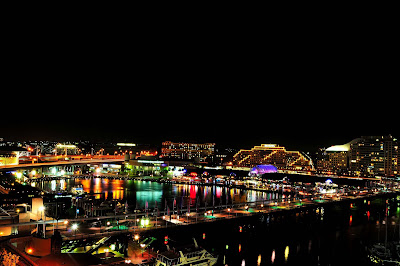
View of Darling Harbour Sydney from hotel room
28 OCT
After 13 hours on a plane from Beijing to Auckland, we took a Qantas flight to Sydney, arriving on Friday afternoon. Although tired from travel, we couldn’t resist a walk along Darling Harbor after checking into our room. It was such a refreshing experience to be back in a familiar feeling environment. We had a good dinner; Dave was ready for a steak, which we hadn’t had in months, and Renee was starved for salad, which we also hadn’t had in a long time. We came back to the hotel with a sense of well being and comfort, and we looked forward to Saturday’s visit with our nephew, Seth, a college student in the Sydney suburbs.
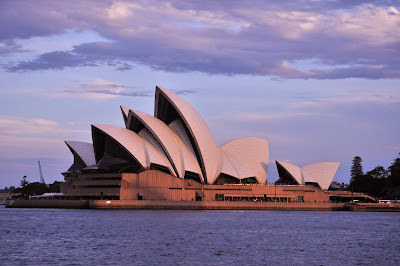
Sydney Opera House at Sunset
29 OCT
Seth met us at our hotel in the morning, and we spent a pleasant day together exploring the harbor area of Sydney. Renee had previously been here 42 years ago when the Opera House was under construction, so our first stop was a tour of the finished product, which was really beautiful. The Opera House and Sydney Harbor Bridge are the major icons by which Sydney is recognized.
We returned to the hotel in the evening and turned on the TV. On the Australian news was a really big story—Qantas had grounded its entire fleet of airplanes both domestic and international due to a labor dispute. Uh oh!! We were supposed to have a Qantas flight on Monday morning to go to Ayers Rock (Uluru). So, what to do? Although we have American Express Travel Insurance, they were not helpful after we finally reached them. The representative mentioned that she was staffing the emergency line (due to the time difference between the states and Sydney) and was unable to even access our policy. There was no way to reach Qantas, even though they had a toll free number. A recording would come on followed by a disconnection. There was no useful information on their website, either.
30 OCT
We had hoped that the government of Australia would have ordered the airline to resume flights while working on a solution to the labor dispute. After all, this situation is an economic disaster with a domino effect that ripples through the whole economy. But, that didn’t happen. We’re staying an extra day here in Sydney, followed by a flight to Cairns a day earlier than we were originally supposed to go. After our stay in the Cairns area, we hope we can continue with our original plans since the other flights are with a subsidiary of Qantas that is still operating.
Today was another beautiful day, even though rain was predicted. We spent the day at the aquarium and the adjoining wildlife center. The highlight of the center was the koalas, especially a baby one that was clinging to its mother.
Koala - Sydney Wildlife Center
The harbor area where we are staying is a virtual hub of activity day and night. The Sydney Rowing Club had a rowing competition in the harbor today. Hundreds of rowers and their boats took part in the event. The rowers were of all ages, young and older. We believe people who live here get out and enjoy the fresh air and athletic activity. They work 8 hours a day and then leave work to enjoy their lives.
31 OCT
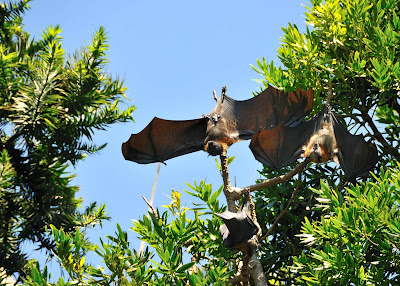
Today was our ‘bonus’ day in Sydney, due to the flight cancellation. So, we decided to go to the Royal Botanic Gardens. What a beautiful park! Immediately upon entering the gardens, we spotted a gorgeous white cockatoo feeding in the grass. We knew that cockatoos were from Australia, but we didn’t expect to see one so quickly and in the city. As we walked farther, there was a lot of bird song and activity in the large, old, multi-branched sprawling trees. The next birds we found were the rainbow lorikeets; we’d previously seen them in bird parks, but, again, we didn’t think we’d see so many of these multicolored beautiful birds in Sydney. As we walked through the park, we came upon a really spectacular sight—large flying fox bats hanging in several of the trees around the park’s café. We started to photograph them, and after a few minutes it occurred to Renee that today was Halloween. Quite an appropriate sight for this day! Some were even flying in the middle of the day. As we watched them fly, we could see the sun shining through their translucent wings, revealing bones and blood vessels.
Flying Fox Bats Royal Botanic Gardens
We meandered around the park for several hours, enjoying the sun and the beautiful trees and landscaping. Around lunch time, hundreds of office workers put on their walking and running shoes, left their offices and went to the gardens to exercise. Some were even doing push-ups in the grass. The thing that was most evident was the fact that people living and working in the city use and enjoy this marvelous place.
1-2 NOV
We arrived in Cairns on a Virgin Australia flight from Sydney. Several Australians with whom we have spoken feel as frustrated as we do about Qantas, and many of them won’t even fly the airline anymore. Many are predicting the airline’s demise by the end of the year. After an hour and a half drive north along the east coast, we arrived at our new destination, Port Douglas. This small town is a resort area where tourists come to explore the rain forest and the Great Barrier Reef. Of course, we intend to do both.
Note: Along the drive, we saw several signs which said, “Don’t Spread Electric Ants”. We have to find out what that’s all about!
We started our orientation to the area with the local Wildlife Sanctuary, home to many regional birds and animals. Australia is home to so many beautiful, colorful birds and indigenous animals (marsupials) found nowhere else on earth that it’s wondrous just to observe it all. We enjoyed seeing and photographing parrots, cockatoos, herons, cassowaries, lorikeets, and many other birds.
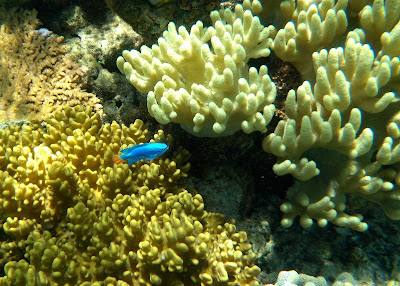
Blue Damselfish-GB Reef
3 NOV Great Barrier Reef
Today was a special day! We experienced another wonder of the world. We cruised out to the Great Barrier Reef in the morning, snorkeled 3 reef systems, and enjoyed lunch and snacks on the boat. Each reef site was a little different, but all were beautiful and colorful. The coral was varied—boulder, brain, stag horn and mushroom corals. Different colors in the coral are a result of algae growing inside it. Some of the blue hues made the coral look like blooming flowers. The lavender coral was really pretty and different.
The fish are even more colorful than the coral--electric blue, neon green, brilliant sunny yellow, orange—so many species of such beauty and colors that it would be hard to describe them all. If you can imagine the most beautiful aquarium that the world could offer coupled with the most gorgeous fish and coral in it, well, that’s what we were swimming around in. It was a marvelous experience!
4 NOV Daintree National Park
Today we took a tour north of the town where we’re staying. We went to the Daintree Rainforest and then continued north on a gravel road to the Bloomfield Waterfall. The Daintree rainforest is the oldest continuous tropical rainforest in the world. We found this fact a bit misleading. To us, ‘oldest’ means really old trees, very big, like Borneo. In fact, most of the trees are not so big. ‘Oldest’ in this case just means that the rainforest has existed uninterrupted over eons of time. Most of the species of trees and plants are very ancient. We followed a coast road through the rainforest with occasional views through the trees of the beach and water. The rainforest meets the ocean here. There are wide beautiful beaches fringing the forested mountains. All of the beaches we’ve seen are nearly empty; you can have a good walk and not see anyone else. Amazing! Sweeping vistas of beach, mountain, and ocean with occasional mangrove trees thrown in for effect comprise the scenery along our route.
At a certain point, we left the asphalt road for a gravel road and continued on to the waterfall, passing an indigenous community en route. There was a sign indicating that it was illegal for anyone to bring alcohol into the town inhabited by the aborigines. It was explained to us that they have a low tolerance for alcohol, and many are alcoholics. Supposedly, the village council appealed to the government asking for help, and the outlawing of alcohol resulted. We since heard on the news that some of the tribal chiefs are angry with the government for renewing the alcohol restrictions into a future time frame. We’re not sure what the truth really is in this matter. The waterfall was scenic, and we enjoyed it.
NOTE: We asked today about the electric ants sign. Electric ants are insects that the government is trying to stop from spreading to other areas. They are asking people not to carry soil from one place to another, etc. So, now I have my answer.
Another aspect of life in Australia that is interesting is the standard of living. We have noticed that prices in restaurants, grocery stores and clothing stores are extremely high. Most things cost at least double what we would pay in the States. When I asked a couple of Australians about it, they mentioned that salaries of workers here are huge. $70,000 per year equates to poverty wages; $150,000 per year salary is needed just to make ends meet, and $200,000 and above is considered comfortable. A waitress makes over $75,000 per year, and Australians don’t tip—that is their salary. Qantas pilot captains make about $400,000 per year and are complaining to their union. Oh well, guess we won’t be moving here on our retirement earnings any time soon!! In a later conversation with Jen, our daughter and financial analyst, she indicated that there isn’t a lot of oil in Australia. It all has to be shipped a long way, which is very expensive and probably contributes greatly to the cost of goods. We believe she is right, since gasoline is about $6-$8 a gallon, depending on where you are in the country. This fact would explain the high cost of food and other items, too. Couple the oil situation with the high wages of the workers and you have an expensive cost of living.
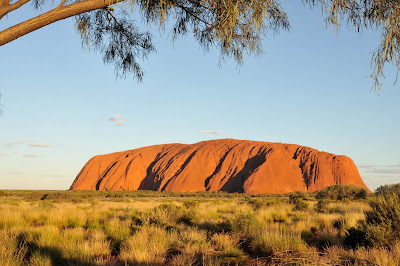
Uluru
6-7 NOV Uluru and Kata Tjuta
The first view of Uluru we had was from the airplane coming in. At first, from the air, it didn’t seem that impressive. We checked into our hotel and were happy to discover that our room had a balcony with a view of Uluru. Our first foray at the site was to photograph the sun setting on the massive monolith. As we got a bit closer to Uluru, we were truly awestruck by the size of the actual sight and its inherent power that makes it a very sacred sight for the Aboriginal people. We drove around Uluru and then parked in the car park designed for sunset photos. We thought it would be crowded, but there was plenty of space for everyone. It was a spectacular sight watching the colors on the rock change as the sun set.
Since we have now driven around the area at different times of the day, we have noticed many changes of colors, hues and the movements of shadows. Some facets of Uluru in the afternoon shadows make it look completely different from the sunshine of the morning. The colors change dramatically—not just Uluru but the soil and the other massive structure here, Kata Tjuta. At one interval, the ground looked ochre, in the bright sunshine it took on a coral color. Colors range through the entire spectrum of reds, oranges and browns and change with the movement of the sun.
For us, it’s another one of those great wonders of the world to be here and see this magnificent icon of Australia. As you drive around Uluru, each area is different due to the way the rocks have weathered and eroded over time. One side might be pock marked with holes and caves, while another area might look as though someone has carved intricate sculptures. There are striations and undulations in the rock that are so parallel they appear to be etched with a ruled pencil.
Although this is the desert, the great red center of Australia, it is remarkably green. There are green grasses called spinoflex; there are trees, some evergreen and some deciduous. There are also many blooming plants with yellow, pink and purple flowers. As you fly over the area, you notice many hues of greens and blues, not bright, but subtle and pastel. A note in the hotel room indicated that there had been a lot of rain lately, so we’re guessing that’s the reason for the relative luxuriance of the terrain.
We left the hotel the next morning at 5:00 AM to catch the sunrise at Kata Tjuta. This sight is about 30 miles from Uluru. It is composed of the same sandstone as Uluru, but instead of a monolith, there are several mountain-like domes close together in the same area. We arrived in time to see the sun rise, which was beautiful. As the light came on to the rocks, colors became more pronounced and vivid. A great photo opportunity!
We also did some hiking around both sights, but by 10:00AM, it was extremely hot and getting hotter. We finished our visit with a tour of the cultural center, which details the history of the aboriginal tribes living here. After that, it was back to the hotel for breakfast and a siesta! We’re glad we were finally able to rearrange our tickets to include this visit which was originally cancelled due to the Qantas grounding.
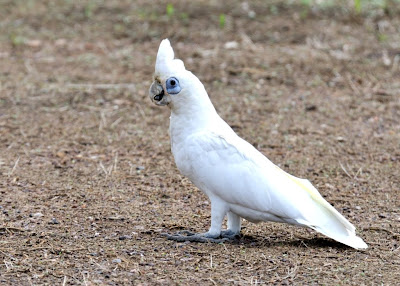
White Cockatoo - Kakadu NP
8-12 NOV Kakadu National Park
After arriving at the Darwin airport at the top of Australia, we drove out to Kakadu National Park, which took about 3 hours. On the way, we saw many birds—lots of hawks in the trees, water birds in the wetlands and when we went to get our park passes at the office, a huge flock of white cockatoos were cavorting, squawking, and feeding in the trees around the park building. Bird life is one of the major reasons people come here to visit.
Next morning, we took a sunrise cruise on the Yellow River. It was a great photo opportunity, with lots of birds and crocodiles. The crocodiles are very dangerous here; they’re large and aggressive. Signs are posted everywhere warning people not to go into the water or even get too close. The boat guide emphasized to us that if we wanted to keep our arms, we shouldn’t put them outside the boat, but use our zoom lenses instead. Ok!! Message received!
Other activities here included visiting the wetlands to observe and photograph the water birds. The wetlands here are what ideal wetlands should be—shallow water and shoreline that is packed with honking, squawking birds: hundreds of geese and ducks, as well as some stilts, spoonbills, egrets, ibises. Even the cockatoos visit the shoreline to feed. The sound of all of these birds is practically deafening. And as you watch in the early morning, hundreds more geese and ducks fly in to take their places with the others. As we walked the trails around the wetland, kangaroos hopped in the bush, sea eagles perched in the treetops, and hawks patrolled airborne in great arcs waiting for an opportunity to secure a meal. The wildlife is really amazing here. We even saw a dingo in the hotel parking lot.
Aboriginal Rock Painting - Nourlangie Rock, Kakadu NP
Kakadu National Park is a traditional home of the Aborigine people of Australia. As with Uluru, they now own the land but lease it back to the Australian government for National Park use. We visited one of the sights of their ancient rock art. The artwork is as vibrant today as it must have been thousands of years ago. Colors of ochre, white and black are the principle hues used in their paintings. Some of the figures are x-ray figures, meaning that they show the bone structure of a human (skeleton). Others are drawings of fictional characters or animals such as kangaroos. The Aborigines of the era that the rock and cave art (thousands of years ago) were produced were said to have been more advanced than their European counterparts (Cro-Magnon man) of the time.
We have really enjoyed Kakadu despite the hot, humid weather and the onslaught of flies every time we park the car and open the doors to get out. The flies are relentless. They fly beneath your sunglasses to harass your eyes, they fly up your nose if you don’t swat them away, and they would fly into your mouth if you opened it. They swarm around you and land on every part of you. Their only redeeming virtue is that they don’t bite. Stores sell nets that you can put over your head or hat to keep them off your face. We thought about getting the nets, but when we saw them for sale, we only had one more day left here.
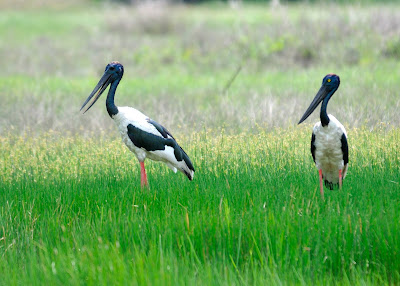
Jabiru Storks
On our way back to Darwin for our late night flight, we stopped at a birding hotspot called Fogg Dam. It is an earthen dam surrounded by wetlands. The amount and diversity of bird life there was astounding. Many different kingfishers, brolgas (cranes), jabiru storks, ducks, geese, egrets, herons, and other water birds inhabit the wetlands. But along the way, the trees were full of other birds, too. Parrots, cockatoos by the hundreds, bee-eaters, kookaburras and more, help to make this area a bird paradise.
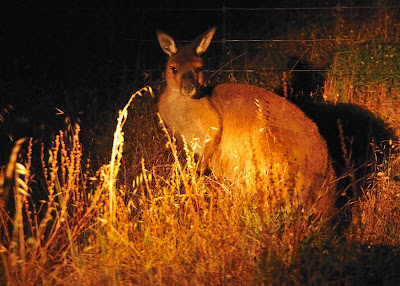
Kanagroo spotted on Night Ride
13-17 NOV Kangaroo Island
Yes, there are kangaroos on Kangaroo Island! Our first adventure on Kangaroo Island was an outing to see the nocturnal animals. We learned that most of the animals on the island are nocturnal and not usually seen during the daytime, including the kangaroos and wallabies. So, off we went in a van with a guide to see what the night would bring. We first viewed wallabies, followed quickly by several kangaroos. Next, we went to a fairy penguin colony to see what was going on there. The adults go to sea during the day to fish for their food, leaving the young ones behind in the nest. Most nights, the adults return to feed the chicks. In one rookery, we could hear the penguins but couldn’t see them. So, we went to a second location where we saw a couple of chicks. The parents don’t always return the same day; sometimes, they stay away a couple of days. On this night, the parent birds were not there. Apparently, the penguin colonies are decreasing in numbers rather rapidly due to predation by the seals.
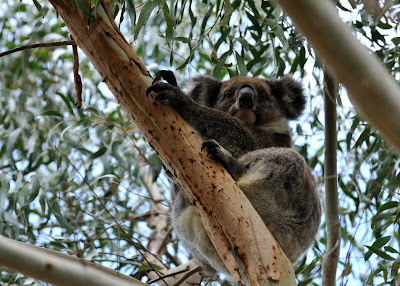
Koala Kangaroo Island
The next morning, we went to the west side of the island. We stopped at a location known to have koalas to see if we could see them. Koalas are not endemic to the island, but when their numbers plummeted on the mainland in the early 20th century, they were introduced here in an effort to save them and increase their numbers. So, now there are about 1,000 on Kangaroo Island. We searched the eucalyptus trees to find the little brown furry balls sleeping within the branches. We saw several, along with parrots and pink cockatoos called galahs. There were bird feeders in the area which attract the parrots. Actually, the pink cockatoos are everywhere. We were surprised to see them shortly after we arrived on the island, and since then, we have viewed them wherever we’ve gone, especially around our hotel.
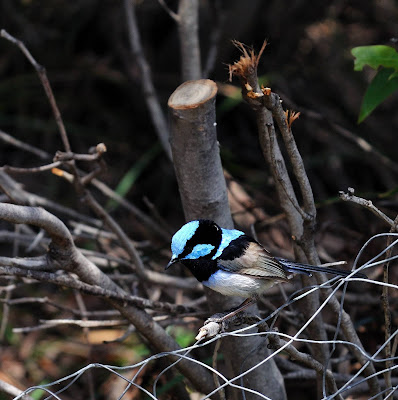
Our next stop was Flinders Chase National Park. The park encompasses a vast area of the western part of the island. It’s famous for its wildlife, magnificent coastline, the Remarkable Rocks (see photos), Admiral’s Arch, and lighthouses. Along the way, we saw an echidna (Aussie version of a porcupine) crossing the road but couldn’t get a photo quickly enough. We’ve also seen many goannas, which are lizards that grow up to 3 feet long. The scenery and views were absolutely breathtakingly beautiful, especially the Remarkable Rocks. As an added bonus, when we stopped at the parking lot for lunch, out popped a gorgeous little blue fairy wren. Dave grabbed the camera and got the lucky shot of the day.
Blue Fairy Wren
Seal Bay was another interesting destination. Along the south coast, Seal Bay is a protected area for Australian Sea lions. We joined a park ranger sponsored walk along the beach to see the seals. As you descend the path to the beach, the first thing you must look out for are the tiger snakes. The weather is warm and they are on the move, but we didn’t see any. These are highly venomous snakes that populate the island. Approaching the beach, once again you are awed and amazed at such a beautiful view. Before you is a wide, white sandy beach framing the multi hued turquoise and deep blue ocean which is populated with sea lions and many, many birds such as little terns and sooty oystercatchers. The seals are lying on the sand, basking in the warmth of the sun. Some are surfing in the water as they come in from feeding. The mature males weigh about 400 kilos, which by my calculation is about 800+ pounds. Is that even possible? We learned that their numbers are declining rapidly, too. They are one of the bellwether species that signal the health or ill health of the ocean. Although this is another sad story, we couldn’t help but feel good that at least a large area of beach, bluffs and dunes has been set aside for them to live and reproduce.
To round out the day, we went hiking at the largest lagoon on the island. The first thing we saw was a large kangaroo grazing on the grass. Apparently, no one told him that he was supposed to be nocturnal. There weren’t too many water birds, although the one that is seen all over the island is the black swan. We’ve seen hundreds of them wherever there is water.
Pennington Beach
We concluded our time on Kangaroo Island with a visit to some nearby sights, including Pennington beach. Again, this is another sight that would knock your socks off. How many colors of blue and turquoise can you count in the water? Many, many!! We stood at the top of the bluffs looking down at the multicolored sea, the waves gently washing ashore onto a wide, white sandy beach. The beach was empty, save for a couple of fishermen. It was a great beach walk on a beautiful beach.
We have really enjoyed our stay in Australia. It’s a gorgeous country with so much to offer. For us, the wildlife and birds were the main attraction, and we were not disappointed. We’ve seen so much and done so much in just a short time of 3 weeks. People here are friendly and cordial. However, we have found that service at hotels and restaurants leaves a lot to be desired. Housekeeping does a minimal job most of the time. Service in restaurants is very frustrating. Sometimes, you feel like the invisible couple. Doesn’t anyone see us? Don’t they know we’ve been waiting 20 minutes to have our order taken? Why is it taking an hour to get the food? Why does it cost $7 or $8 just to get a skimpy plate of bread to munch while we wait for the food to come? Or maybe we’re just getting tired of eating in restaurants after 4 months of travel? More and more, if we have a room with a minibar, we’re going to the grocery store and buying things to have for breakfast and lunch, instead of hassling with restaurants. Now, if we can just solve the dinner dilemma!
Now off to New Zealand!
Pictures: Due to the additional number of pictures we wanted to post for Australia, please view them at our photo website below.